AI agents are becoming common in discussions about automating business processes. But should an AI agent be created for every process that can be automated?
Not necessarily.
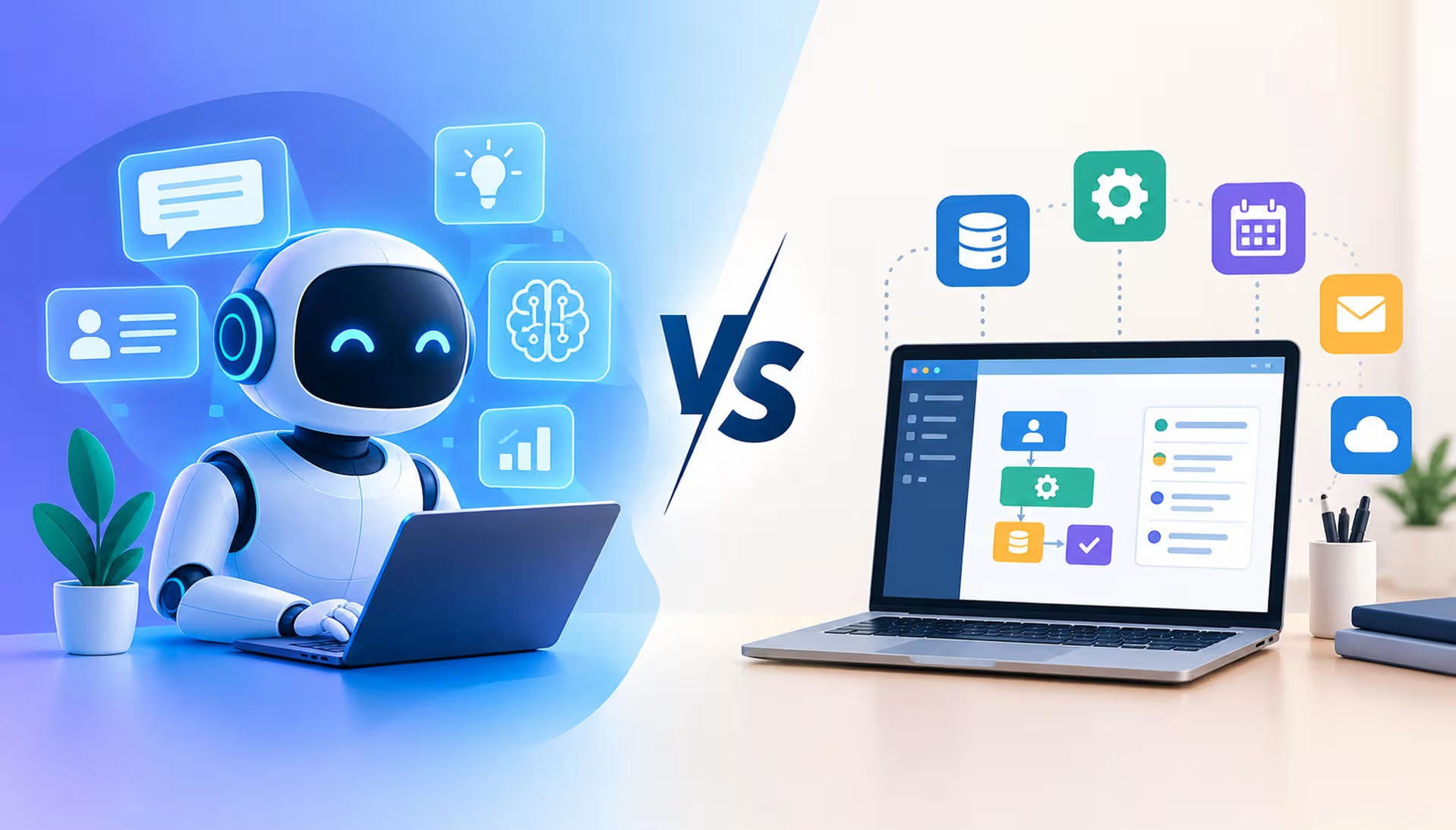
In some cases, traditional software may be the best solution. In others, an AI agent may be better suited to the process. The important thing is to understand the business requirement before deciding between the two.
Traditional Software Follows the Process You Define
Most business software allows a business to define the rules that it then implements.
For example, what is the process for capturing and managing a lead?
A customer fills in a contact form on the website. The information is then added to the business’s CRM. A rule then determines which salesperson owns the lead. The salesperson then reaches out to the customer on WhatsApp.
This process can be automated by defining the rules for each step.
Website Contact Form → CRM → Assign Lead → Send WhatsApp Message
There are many traditional software solutions that can automate different business processes, including accounting, payroll, appointment scheduling and ERP systems.
Can this problem be solved by defining a set of rules?
If the answer is yes, then going the traditional software route may be the better way to solve this.
When an AI-Based Approach May Be Better
A task usually needs some level of interpretation or unpredictability to warrant the use of an AI approach.
Let’s assume a company has hundreds of customer enquiries each day.
These enquiries may be to check pricing, to make a complaint, to request a refund, to reschedule an appointment, or to get more information about a product.
Traditional workflow applications can be programmed to automatically route customer enquiries based on pre-defined rules.
What happens when the system is required to understand customer enquiries, retrieve related information and take the next appropriate action?
In this scenario, an AI approach would be appropriate.
To break this down into simple terms:
Customer Enquiry → AI Understands the Request → Retrieves Relevant Data → Responds / Acts Upon the Request → Updates CRM
An AI agent can be given a certain level of flexibility and can take actions within the constraints defined by the system.
There should be defined limits on the decisions an AI agent is allowed to make.
AI Agents Are Not a Substitute for Business Rules
It is a misconception to think that an AI agent is a substitute for an entire business process.
A good example is using an AI agent for the initial assessment of a sales lead.
The AI agent may be able to retrieve the lead information and suggest additional questions to understand the lead’s needs. However, the business needs to define what constitutes a sales lead for the business.
Is it the budget? Location? Company size? Requirement? Timing?
An AI system can help assess this information, but the business still needs to define the rules for what makes a lead qualified.
This is true for customer service as well.
A customer service AI agent can answer basic questions or classify customer requests. However, certain situations may still require an employee—for example, a refund above a specified amount, an unhappy customer or an unusual service request.
Decimal Technologies can help evaluate whether an AI agent, traditional automation or a combination of both is more appropriate for your business process.
Related service: Custom Software Development for processes that need tailored workflows, integrations or automation.
AI and Traditional Software Can Work Together
A business does not always have to choose one or the other. Traditional software can manage structured tasks such as storing customer information, updating records and triggering workflows, while an AI agent can help interpret customer enquiries or decide which predefined workflow should handle them.
For example, a CRM can continue to manage the customer record while an AI agent understands the enquiry and helps determine the next appropriate action.
In processes where human involvement is not needed for engagement or interpretation, AI may not be necessary. Traditional software may be enough to handle the process.
If an invoice is approved when three defined conditions are met, a rule-based workflow can process it.
When an order reduces inventory, an integration can automatically adjust the inventory level.
When a payment is confirmed, a rule can trigger a payment confirmation for the customer.
When the rules governing a process are well defined and consistency is important, traditional software can be used to automate the process.
Interpreting and Classifying
AI can assist with activities that involve interpreting, classifying and analysing information. This may include classifying support requests, qualifying leads, summarising reports or suggesting responses based on an approved knowledge base.
Before Choosing AI, Look at the Process
Before deploying an AI agent, look at the process itself. Which steps are currently handled manually? Which steps follow clear rules? Where do employees need to interpret information or make a decision? What systems are involved? What happens when something unusual occurs? And where should an employee review or approve the outcome?
Answering these questions can help determine whether the process needs traditional automation, an AI agent or a combination of both.
How Decimal Technologies Approaches AI and Automation
At Decimal Technologies, AI and automation are considered after evaluating the business need.
For many businesses, integrating a CRM or automating WhatsApp communication may solve part of the requirement. Other businesses may need customised automation or custom software. Where a process requires interpreting information, communicating with customers or deciding between different actions, an AI agent may also be useful.
For customer-facing automation, see Decimal’s WhatsApp Business Solution.
In some cases, the best solution may be to combine automation, custom software and/or AI.
Our goal is to evaluate the business need and recommend the most appropriate solution, which may include the use of AI.
If you’re considering an AI agent but aren’t sure whether it is the right solution, talk to Decimal Technologies about the business process first.